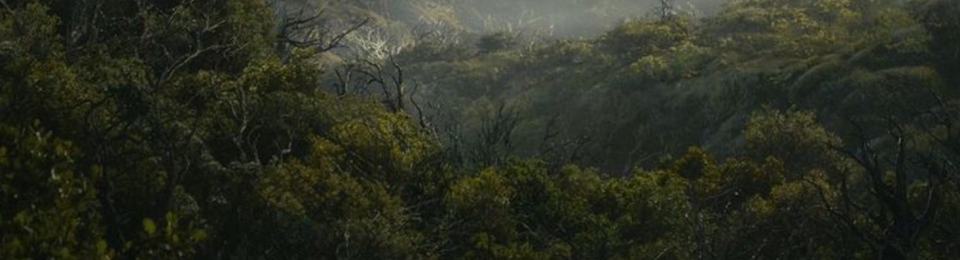
Mirkwood, previously Greenwood the Great, is in many ways the most iconic and well known forest in Middle-earth, even though it hardly features in Lord of the Rings.
Mirkwood once formed part of the vast primeval woodland which covered most of Middle-earth during the Years of the Trees. In the 2nd and 3rd age Mirkwood was a temperate broadleaf and mixed forest located in the region of Rhovanion, east of the great river Anduin. It lay east of the Misty Mountains’ rain shadow and had a humid-continental climate; winters were cold throughout but much longer in the north, while the south had hotter summers.
This was a vast forest; according to Gandalf it was “the greatest forest of the Northern world.” It stretched about 675 km from north to south, and was up to 320 km wide from east to west. The shape of Mirkwood (on north-oriented maps) evokes the profile of a person’s head and shoulders, with a beard or pronounced chin facing eastwards. The ‘neck’ of the forest was known as the Narrows, which was about 120 km wide from the western eaves to the East Bight.
The trees of the forest were generally large and densely packed. In the north they were mainly oak, although beeches tended to predominate in the areas favoured by Elves. Higher elevations in Southern Mirkwood were “clad in a forest of dark fir”. Smaller plants and undergrowth in Mirkwood included lichen, ivy, fungus and various herbs. In autumn, various plants bore edible nuts.
A variety of animals inhabited the forest. There were mammals such as deer, squirrels and bats, and there were numerous insects including moths, flies and unidentified nocturnal species. Pockets of the forest were dominated by giant Spiders. Some of the animals included endemic black varieties to match the mirk of the forest: for example squirrels and purple emperor butterflies.
Mirkwood could only be crossed by two routes. The main one was the Old Forest Road, to the north of the centre of the forest. Further north there was the little-known Elf-path.
The Mountains of Mirkwood (Emyn Fuin, formerly the Emyn Duir or “Dark Mountains”) rose in the midst of the forest, between the Old Forest Road and the Elf-path. The Enchanted River flowed from these mountains to join the Forest River, which also ran through the forest’s north.
The Woodland Realm was established by Oropher in S.A. 750, a Sindarin lord of Doriath, after the War of Wrath. Unlike most Sindar, Oropher and his household declined the Valar’s offer to depart from Middle-earth for Valinor. Instead he migrated eastward and became the King of the Nandor of Greenwood the Great. The few Sindar who had come with him were soon merged with the Silvan Elves, adopting their customs and language and taking names of Silvan form and style. Oropher and his household wished to return to a simple existence natural to the Elves before they had been disturbed by the Valar.
Originally Oropher’s realm encompassed the entirety of Greenwood, with its capital at Amon Lanc. However, during the Second Age, he and his people migrated north three times. According to one tradition, the first movement was northward beyond the Gladden Fields, due to Oropher’s desire to distance himself from the increasing encroachments of the Dwarves of Moria and his resentment of the intrusions of Celeborn and Galadriel in Lothlórien. However his people did maintain constant intercourse with their kin west of the Anduin. Oropher was also disturbed by the reports of Sauron’s rising power and by the end of the Second Age he dwelt in the western glens of the Emyn Duir or Dark Mountains and his people lived north of the Men-i-Naugrim or Dwarf-road.
Oropher’s son, Thranduil, succeeded him as king of the Woodland Realm[2] and ruled for the duration of the Third Age.
Around T.A. 1050 an evil entity known as the Necromancer (later identified as Sauron) inhabited the abandoned halls of Amon Lanc, and Greenwood grew infested with Orcs and giant Spiders. The Wood-elves retreated yet further north and many landmarks were renamed: Greenwood became Mirkwood, the Emyn Duir the Mountains of Mirkwood or Emyn-nu-Fuin, and Amon Lanc was known as Dol Guldur, the Hill of Sorcery.
By the middle of the Third Age, the Silvan Elves of Mirkwood were much reduced in number though Mirkwood still had a greater population of Elves than Lindon, Rivendell, or Lothlórien. To avoid the encroachment of the Necromancer from the south, they dwelt in the lands north of the Forest River, living mainly in and around the Elvenking’s Halls. They also had become increasingly withdrawn and wary of strangers, though they did trade with the neighbouring realms of Erebor and Dale, and imported wine from Dorwinion via the River Running. The former traffic came to an end upon with the destruction of Erebor by the dragon Smaug in T.A. 2770, who also attacked the Woodland Realm itself, putting further pressure on the beleaguered elves.
 Wandering Noldo